
Gold Coast Airbnb Tax Guide for Owners: Navigating 2026 Regulations
Published · Updated

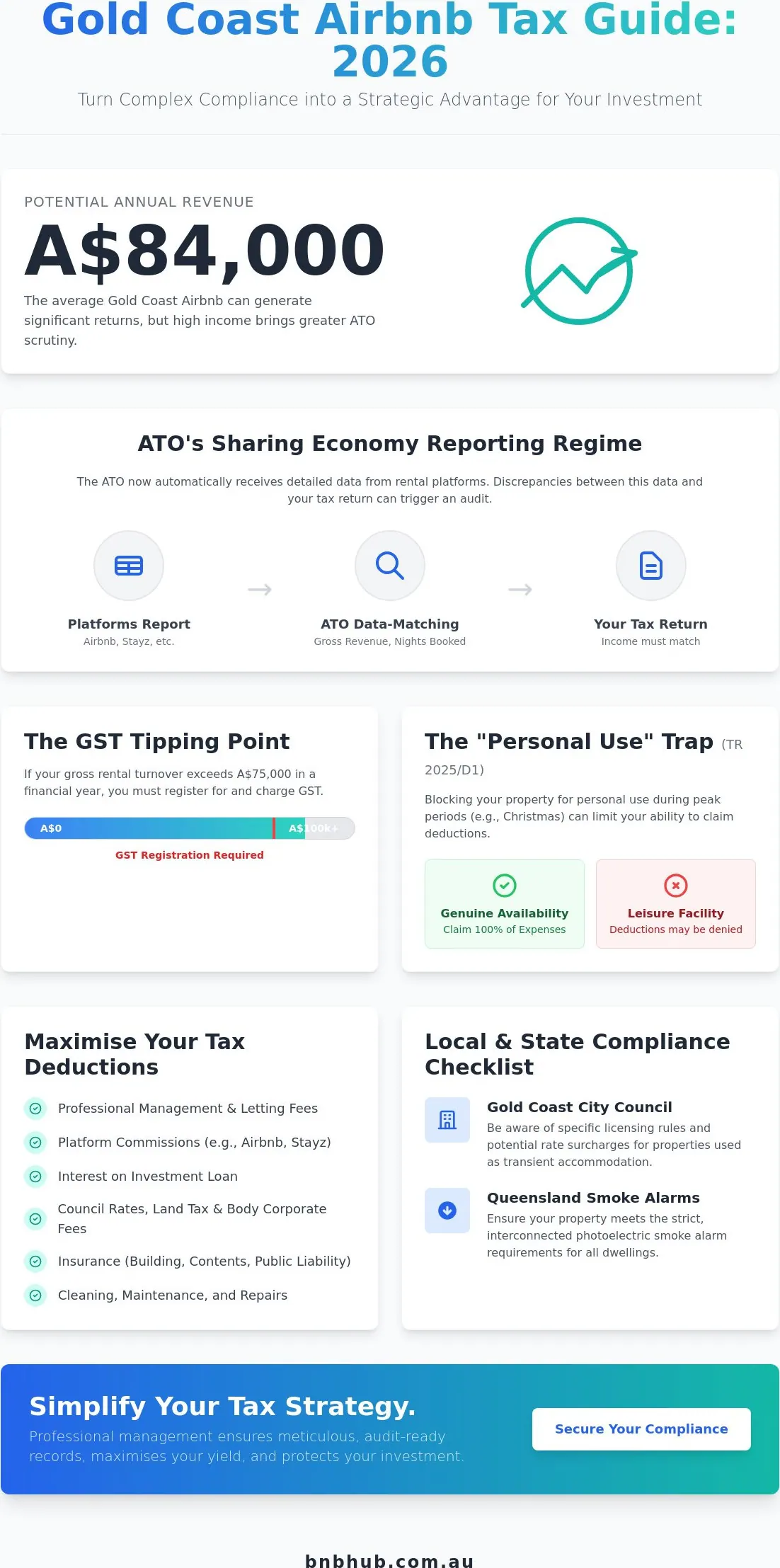
With the average Gold Coast Airbnb generating up to A$84,000 in annual revenue, the difference between a thriving investment and a tax headache often comes down to a single ATO ruling. As a property owner, you’ve likely felt the weight of increasing scrutiny from the Australian Taxation Office, especially with the new TR 2025/D1 “Leisure Facility” interpretation. This Gold Coast airbnb tax guide for owners is designed to alleviate that stress by turning complex compliance into a strategic advantage for your portfolio.
We understand that tracking dozens of small expenses while worrying about the A$75,000 GST threshold can feel overwhelming. You deserve to enjoy your passive income without the constant fear of a surprise audit or complex body corporate disputes. This guide will help you master your tax obligations and maximise your investment yield for the 2026 financial year. We’ll preview the essential steps for claiming full ownership deductions, explain the latest Queensland smoke alarm requirements, and clarify the specific Gold Coast City Council licensing rules you need to know. It’s time to secure your compliance and unlock the true potential of your short-term rental.
Key Takeaways
- Understand how the ATO’s Sharing Economy Reporting Regime uses advanced data-matching to monitor your short-term rental income in 2026.
- Identify the specific triggers for the A$75,000 GST threshold and how it applies to your holiday rental turnover.
- Use this Gold Coast airbnb tax guide for owners to uncover 100% tax-deductible expenses, including professional management fees and platform commissions.
- Navigate the financial implications of Gold Coast City Council rate surcharges for transient accommodation to protect your net rental yield.
- Discover how bespoke financial reporting and meticulous record-keeping can simplify your tax season while ensuring you remain audit-ready.
Table of Contents
- Navigating Airbnb Tax Obligations for Gold Coast Owners in 2026
- Understanding Income Tax, GST, and Capital Gains Implications
- Maximising Your Yield: Essential Tax Deductions for 2026
- Gold Coast Council Regulations and QLD State Compliance
- Simplifying Your Tax Strategy with Professional Management
Navigating Airbnb Tax Obligations for Gold Coast Owners in 2026
The Australian taxation landscape has shifted from voluntary disclosure to automated transparency. For hosts across Broadbeach, Surfers Paradise, and Burleigh Heads, the 2026 financial year introduces sophisticated oversight that makes manual record-keeping a significant risk. This Gold Coast airbnb tax guide for owners breaks down how the Sharing Economy Reporting Regime changes the way you interact with the ATO and protects your investment yield.
The ATO now receives direct data feeds from platforms like Airbnb and Stayz. This isn’t just about total income; it includes the number of nights booked, specific dates of stay, and gross revenue earned before platform fees. Because this information is matched against your individual tax return, any discrepancies will likely trigger an automated query. Understanding the foundational principles of Taxation in Australia is the first step toward building a compliant, high-yield investment strategy that stands up to scrutiny.
The ATO’s Stance on Short-Term Rentals in 2026
The tax office differentiates between casual hosting and a commercial enterprise based on “genuine availability.” To claim 100% of your property expenses as deductions, you must prove the property was available for rent at market rates during peak periods. If you reserve the property for yourself or friends during Christmas or Easter, the ATO may view it as a leisure facility under the TR 2025/D1 ruling. This ruling, set to apply from July 1, 2026, could result in a proportional denial of interest, rates, and insurance deductions if personal use is deemed significant.
Residential rent is generally input-taxed, but short-term stays are treated differently. If you provide additional services or operate multiple units, the ATO may classify your activity as running a holiday rental business rather than just receiving rental income. This distinction is vital for your long-term yield and influences how you manage your capital gains tax (CGT) obligations later. Commercial residential premises have distinct GST implications that require meticulous record-keeping from day one to ensure you aren’t overpaying.
Why 2026 is a Pivotal Year for Compliance
Data-matching capabilities have reached a new level of precision this year. The ATO is specifically targeting holiday homes where owners claim full deductions despite significant personal use. In Queensland, local council reporting and the upcoming 2027 smoke alarm deadlines are forcing a more rigorous approach to property management. Using a comprehensive Gold Coast airbnb tax guide for owners helps you stay ahead of these changes before they impact your net yield.
Owners must now provide evidence of active management and commercial pricing to defend their tax position. We define the 2026 tax landscape for Gold Coast investors as highly transparent and data-driven. Professional management doesn’t just improve your guest experience; it creates the audit-ready trail necessary to protect your financial returns. By treating your property as a high-end hospitality asset rather than a side hobby, you unlock greater deductions and the peace of mind that comes with total compliance.
Understanding Income Tax, GST, and Capital Gains Implications
Generating a premium yield from your property is rewarding, but it’s essential to understand how the ATO views your earnings. This Gold Coast airbnb tax guide for owners simplifies the three financial pillars that affect your net return. Your total Airbnb revenue, which includes cleaning fees and guest service charges, is added to your other assessable income for the financial year. According to the Australian Taxation Office (ATO) guidelines, you must declare all rental-related payments regardless of whether they stay in your platform account or are transferred to your bank.
Because these earnings are taxed at your marginal rate, serious investors often look for ways to offset this liability. Professional Airbnb management Gold Coast fees are 100% tax-deductible, providing a strategic way to reduce your taxable income while elevating your property’s performance. It’s a savvy move that replaces your personal labour with expert systems while keeping your financial records audit-ready.
The GST Threshold for Holiday Rentals
Most residential Airbnb hosts on the Gold Coast don’t need to worry about GST. In Australia, residential rent is generally input-taxed, meaning you don’t charge GST on stay fees. However, if your total turnover from all business activities, including your short-term rental, exceeds A$75,000 per year, you must register for GST. This usually only applies if the ATO classifies your property as “commercial residential premises,” such as a hotel or boarding house, which is rare for standard apartment or house listings. For most, staying below this threshold keeps your administrative burden light.
| Tax Factor | Individual Host | Company Structure |
|---|---|---|
| Tax Rate | Marginal rates (0% to 45%) | Fixed rate (typically 25%) |
| CGT 50% Discount | Eligible after 12 months | Not eligible |
| Medicare Levy | 2% applicable | Not applicable |
Capital Gains Tax (CGT) and Your Main Residence
Using your principal place of residence for Airbnb can impact your “main residence exemption” for CGT. If you rent out a room or the entire home while you’re away, you’ll likely lose a portion of this exemption. The ATO requires you to apportion the capital gain based on the floor area used for income and the length of time it was available for rent. If you move out entirely, the “6-year rule” may allow you to treat the property as your main residence for up to six years, provided you don’t claim another property as your primary home during that time.
We recommend obtaining a professional valuation before you first list the property. This establishes a “cost base” at the time it began producing income, which can save you thousands in tax when you eventually sell. Managing these nuances requires precision, which is why many owners choose to partner with a local expert to ensure every financial detail is meticulously handled from day one.
Maximising Your Yield: Essential Tax Deductions for 2026
Maximising your net rental yield isn’t just about securing a high occupancy rate; it’s about what you keep after the tax season ends. For those using this Gold Coast airbnb tax guide for owners, the path to a higher return starts with identifying every available deduction. The ATO allows you to claim expenses that are directly related to the income-producing use of your property. This includes everything from platform commissions to the local council rates you pay to maintain your investment’s standing in the market.
A common misconception is that professional management is an added financial burden. In reality, property management Gold Coast fees are 100% tax-deductible. This means you can offset the entire cost of expert oversight against your rental income, effectively lowering your taxable profit while enjoying a hands-off investment experience. It’s a savvy way to replace your personal labour with professional systems while retaining more of your hard-earned revenue.
Management and Service Fees
Percentage-based commissions charged by your management partner are fully claimable. This extends to guest communication, booking coordination, and the administrative costs of running your listing day-to-day. While you must declare cleaning fees passed to guests as income, as noted in the Australian Taxation Office guidelines on rental income, the actual cost of the cleaning service and linen hire is a direct deduction. This balance ensures your financial reporting remains transparent and compliant without eating into your net profit.
Maintenance, Styling, and Photography Costs
Professional photography is more than just a marketing tool; it’s a deductible business expense that directly impacts your listing’s performance. Similarly, bespoke property styling is a strategic investment. While it serves to increase your occupancy rate, which averages 78% on the Gold Coast, the costs associated with furnishing your rental are generally claimable through depreciation. For assets like lamps or small kitchen appliances costing less than A$300, you can typically claim an immediate deduction in the year of purchase.
For more significant investments, such as high-end furniture packages or air conditioning units, you’ll need to follow a depreciation schedule. This document, prepared by a quantity surveyor, allows you to claim the “wear and tear” of your assets over several years. Structural improvements, known as capital works deductions, are also available for properties built after September 1987. With the January 1, 2027 deadline for interconnected photoelectric smoke alarms in Queensland approaching, ensure these installations are recorded. These compliance-driven costs are essential for producing rental income and are fully deductible, protecting your net yield as regulations evolve.
Gold Coast Council Regulations and QLD State Compliance
Compliance is a prerequisite for a high-yield investment. In the local market, staying ahead of municipal requirements ensures your property remains a viable asset rather than a liability. This Gold Coast airbnb tax guide for owners highlights that while federal tax is fixed, local regulations are dynamic. Navigating the City of Gold Coast (GCCC) framework requires precision, particularly as the council increases its oversight of short-term rentals across the coast.
Under Local Law 16, the GCCC requires operators of short-term accommodation businesses to hold a valid approval. This licence expires on August 31st each year. While there are currently no fees to establish this business according to the Australian Business Licence and Information Service, the financial impact often appears in your rates notice. GCCC frequently reclassifies properties used for “transient accommodation,” which can lead to significant rate surcharges. These extra costs are fully tax-deductible, but they must be factored into your annual revenue projections to protect your net yield.
Local Planning Schemes and Permits
The council has become increasingly data-driven in its approach to audits. Unlisted or unapproved properties now face higher risks of discovery through platform data-matching. Beyond simple registration, your property must meet specific fire safety standards. Queensland legislation mandates that by January 1, 2027, all short-term rentals must have interconnected photoelectric smoke alarms. The cost of purchasing and installing these systems is a deductible expense. For high-rise owners in Surfers Paradise, ensuring your unit complies with the building’s broader fire safety management plan is essential for maintaining your insurance coverage and your tax-deductible standing.
Body Corporate (Strata) Tax Considerations
In high-density areas like Broadbeach and Main Beach, body corporate by-laws play a major role in your daily operations. While some schemes have attempted to restrict short-term stays, many owners successfully navigate these rules through professional management. Any special levies or increased insurance premiums imposed by your strata due to short-term rental activity are generally 100% tax-deductible. This includes costs for noise monitoring technology or additional security services required to maintain harmony within the building.
Reviewing your by-laws annually is a savvy move for any discerning owner. If your body corporate requires specific administrative fees for processing guest arrivals, ensure these are meticulously recorded in your financial statements. To ensure your property meets every local requirement while maximising your returns, consider how professional Airbnb management Gold Coast can streamline your compliance and protect your investment from regulatory surprises.
Simplifying Your Tax Strategy with Professional Management
Managing a premium short-term rental is a sophisticated financial operation that extends far beyond greeting guests and changing linens. As this Gold Coast airbnb tax guide for owners has demonstrated, the intersection of ATO data-matching, GST thresholds, and local council surcharges creates a complex environment for any investor. Professional management serves as your strategic partner, transforming these regulatory hurdles into a seamless, high-yield system that protects your time and your profit.
The “Hassle-Free” promise at Bnb Hub is built on the foundation of transparency. We understand that your peace of mind depends on knowing exactly where every dollar goes. By consolidating all revenue and expenses into meticulous monthly and annual financial statements, we remove the administrative burden from your shoulders. You won’t need to hunt for cleaning invoices or platform fee summaries at the end of the financial year. Instead, you receive a single, comprehensive report that is ready for your accountant, ensuring you never miss a valid deduction.
Accurate Record Keeping and Reporting
Digital precision is the only way to stay ahead of the ATO’s Sharing Economy Reporting Regime. We utilise advanced digital reporting tools to track every transaction in real-time, providing a single point of truth for your property’s financial performance. This meticulous approach prevents the common “leakage” of small, untracked expenses that can collectively cost you thousands in lost tax offsets. “Professional management transforms a chaotic shoebox of receipts into a streamlined, audit-proof financial asset.” This level of detail doesn’t just simplify your life; it mitigates the risk of non-compliance and ensures your property stands up to any level of scrutiny.
Unlocking Passive Income Without the Admin
Many Gold Coast owners find success through a Dual Strategy Management approach, which balances the high yields of holiday stays with the stability of student or executive rentals. Each of these strategies carries different tax treatments, and managing the transition between them can be a reporting nightmare for the unassisted owner. We handle the complexity of these mixed-use properties, ensuring that your income and expenses are apportioned correctly according to current legislation.
Whether you’re navigating the capital gains implications discussed earlier or managing the immediate write-off of new property styling, our team ensures your records are flawless. We don’t just manage buildings; we curate financial outcomes that allow you to enjoy the rewards of property ownership without the stress of the back-office admin. It’s time to stop worrying about the paperwork and start focusing on your property’s growth. Unlock your property’s full potential with a free income appraisal and see how professional oversight can elevate your 2026 investment yield.
Secure Your Investment and Unlock Greater Yield
Navigating the 2026 tax landscape requires more than just basic record-keeping; it demands a proactive strategy. From understanding the ATO’s intensified data-matching to meeting the looming Queensland smoke alarm deadlines, staying ahead of regulations is the key to protecting your net rental yield. This Gold Coast airbnb tax guide for owners has provided the essential framework to help you manage your obligations while maximising every available deduction, from property styling to strata levies.
Success in the Gold Coast market is built on a foundation of transparency and expert local knowledge. Since 2018, we’ve helped owners replace the stress of compliance with the rewards of passive income. By leveraging our 100% tax-deductible management fees and consolidated, tax-ready monthly reporting, you ensure your investment remains audit-proof and high-performing. It’s time to stop worrying about the paperwork and start enjoying the lifestyle upgrade your property provides.
Maximise Your Gold Coast Airbnb Returns with Bnb Hub. Your investment is a valuable asset; let’s work together to ensure it reaches its full potential with total peace of mind.
Frequently Asked Questions
Do I need to declare my Gold Coast Airbnb income to the ATO?
Yes, you must declare every dollar of income generated by your short-term rental to the ATO. This includes the gross amount earned from guest stays, cleaning fees, and any other charges before platform commissions are deducted. Because the Sharing Economy Reporting Regime provides the ATO with direct data from platforms, maintaining total transparency is the only way to ensure compliance.
What are the most common tax deductions for Airbnb owners on the Gold Coast?
Common deductions include platform service fees, professional cleaning costs, linen hire, and property maintenance. You can also claim a portion of your council rates, insurance premiums, and the interest on your investment loan. This Gold Coast airbnb tax guide for owners recommends using digital tracking to capture every small expense, as these collectively protect your net rental yield.
Is Airbnb management 100% tax-deductible in Australia?
Professional property management fees are 100% tax-deductible in Australia. This means the cost of hiring an expert to handle your guest communication, booking management, and listing optimisation is fully offset against your rental income. It’s a savvy financial move that allows you to enjoy a passive lifestyle upgrade while lowering your overall taxable profit.
How does renting my property on Airbnb affect my Capital Gains Tax (CGT)?
Renting out your property generally triggers a proportional CGT liability, even if it’s your principal place of residence. You’ll likely lose a portion of your main residence exemption based on the floor area used for guests and the length of time it was available for rent. Obtaining a professional valuation before you start hosting is a meticulous step that establishes a clear cost base for the future.
Do I need to charge GST on my Gold Coast short-term rental?
Most residential Airbnb hosts don’t need to charge GST because residential rent is typically input-taxed. However, if your total annual turnover from all business activities reaches the A$75,000 threshold, you must register for GST. This requirement usually only applies to large-scale operations or those the ATO classifies as “commercial residential premises” like a boutique hotel.
Are professional styling and photography fees tax-deductible?
Bespoke styling and professional photography are fully deductible as they are essential for generating rental income. Photography is generally claimed as an immediate marketing expense, while furniture and styling packages are depreciated over their effective life. These investments are key to standing out in a competitive market and achieving the Gold Coast’s average daily rate of A$311.
What happens if I use my Gold Coast Airbnb for personal holidays?
Personal use of your property requires you to reduce your tax deductions proportionally. If you or your friends stay in the home for three weeks of the year, you must reduce your annual claimable expenses by that percentage. The ATO’s 2026 “Leisure Facility” ruling makes this even more critical, as significant personal use during peak periods can jeopardise your ability to claim interest and rates.
Does the Gold Coast City Council charge extra rates for Airbnbs?
The Gold Coast City Council often applies a higher rate category to properties used for short-term accommodation. Once a property is identified as “transient” or commercial-use, your annual rates notice will likely include a surcharge. While these increased costs are fully tax-deductible, they must be factored into your financial planning to ensure your net rental yield remains at its peak.