
Gold Coast Short Term Rental Regulations 2026: The Complete Investor’s Compliance Guide
Published · Updated
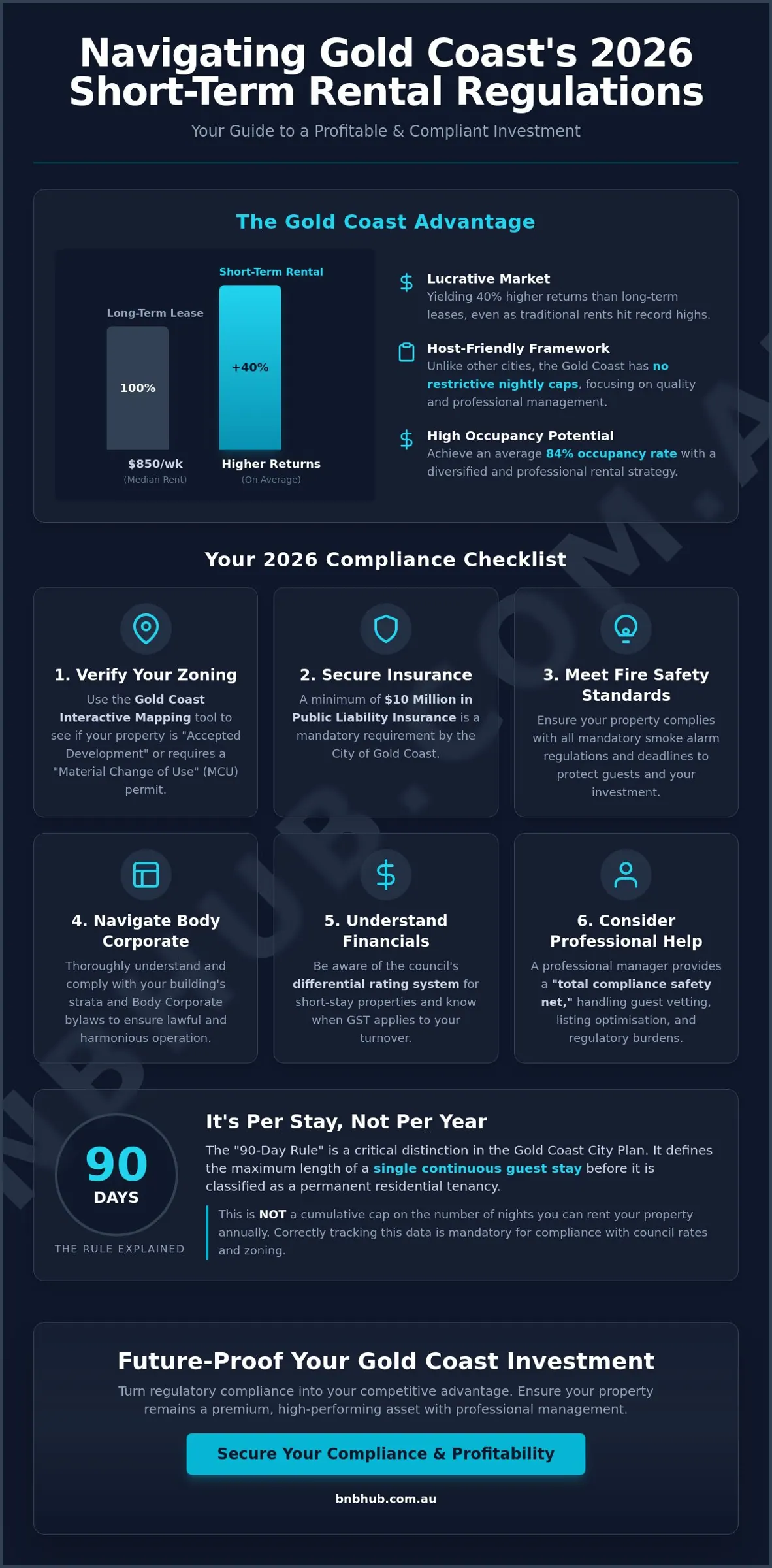
Did you know that Gold Coast short-term rentals are currently yielding 40% higher returns than long-term leases, even as local median rents hit a record $850 per week? It’s a lucrative market, but the landscape is shifting. You likely feel a lingering unease about the Gold Coast short term rental regulations 2026, especially with the City of Gold Coast increasing rates for short-stay properties and requiring $10 million in public liability insurance. We understand the frustration of balancing zoning approvals with Body Corporate expectations while trying to avoid heavy council fines.
This guide promises to simplify the complexity, giving you the clarity needed to keep your investment legal, profitable, and entirely stress-free. We’ll explore the critical requirements for Material Change of Use (MCU) applications, the mandatory smoke alarm deadlines, and how to maintain a high 84% occupancy rate through a diversified rental strategy. You’re about to unlock a professional framework that turns regulatory compliance into your greatest competitive advantage, ensuring your property remains a premium, high-performing asset in Australia’s most sought-after holiday destination.
Key Takeaways
- Identify your property’s zoning status using the Gold Coast Interactive Mapping tool to determine if your hosting qualifies as “Accepted Development.”
- Stay ahead of the Gold Coast short term rental regulations 2026 by meeting mandatory fire safety standards and public liability insurance minimums.
- Protect your yield by understanding the council’s differential rating system and how GST applies once you reach specific turnover thresholds.
- Navigate the complexities of Body Corporate bylaws to ensure your short-term rental remains a lawful and welcome part of your building community.
- Discover how professional management provides a total compliance safety net, from rigorous guest vetting to meticulous listing optimisation.
Table of Contents
- Understanding the 2026 Gold Coast Short-Term Rental Framework
- Zoning, Permits, and Planning Approvals for Hosts
- Strata, Body Corporate, and Safety Compliance
- Financial Obligations: Rates, Taxes, and ROI Optimisation
- Future-Proofing Your Investment with Bnb Hub
Understanding the 2026 Gold Coast Short-Term Rental Framework
The Gold Coast short term rental regulations 2026 represent a maturing market that prioritises professional standards over amateur hosting. Under the current Gold Coast City Plan, “Short-term Accommodation” is defined as the use of a dwelling to provide for tourists or travellers for a period of less than three consecutive months. Unlike other major Australian cities that have introduced restrictive nightly caps, the Gold Coast, Queensland remains remarkably host-friendly. The council has chosen not to limit the total number of nights you can rent your property each year, focusing instead on how the property is managed and its impact on the local community.
This regulatory environment creates a unique opportunity for investors. While the framework is supportive, there’s a clear shift toward professionalised management. The council now expects hosts to operate with the same level of meticulous care as a boutique hotel. By focusing on high-end guest experiences and rigorous compliance, you can unlock the full potential of your asset. This is where professional Listing Optimisation and Revenue & Booking Management become essential tools for the discerning owner who wants to stay ahead of the curve.
The 90-Day Rule Explained
Confusion often surrounds the “90-day rule,” but it’s a vital distinction for your legal compliance. This threshold refers specifically to the length of a single guest stay, not a cumulative yearly cap. If a guest stays for more than 90 consecutive days, the occupancy typically shifts from “Tourist” use to a permanent residential tenancy. Tracking this guest data is now a mandatory compliance step. It ensures your property is correctly categorised for council rates and meets the specific zoning requirements for short-term stays. Failing to distinguish between these uses can lead to unexpected tax implications or disputes regarding your property’s primary function.
Gold Coast City Plan 2026 Updates
Recent amendments to the City Plan have introduced targeted oversight for high-density precincts like Surfers Paradise and Broadbeach. The council’s proactive stance aims to support the tourism economy while aggressively mitigating “Party House” issues and noise complaints. These updates aren’t designed to restrict your income; they’re intended to protect the long-term viability of the industry. By staying ahead of the Gold Coast short term rental regulations 2026, you protect your property’s yield while delivering a bespoke guest experience. The 2026 framework rewards hosts who treat their rental as a sophisticated business, ensuring the Gold Coast continues to lead as Australia’s premier destination for savvy property investors.
Zoning, Permits, and Planning Approvals for Hosts
Your first step toward a compliant investment is mastering the Gold Coast Interactive Mapping tool. This digital resource is the final word on how your property is classified within the city’s complex landscape. By entering your address, you can instantly see if your asset sits within a precinct that encourages tourism or one reserved for quiet residential life. Understanding these Gold Coast short term rental regulations 2026 early prevents the heartbreak of purchasing a property that cannot legally be used for short stays. It’s about securing your peace of mind before the first guest even arrives.
In many high-density areas, your property might be classified as “Accepted Development.” This means you can operate without a formal development application, provided you meet the City of Gold Coast rental accommodation standards. However, if your property is “unhosted” (meaning you don’t live on-site) and located in a residential zone, you’ll likely require a Material Change of Use (MCU) approval. This is a formal planning permit that confirms your property is suitable for commercial guest use. While the process is rigorous, it provides a legal shield that protects your investment’s longevity.
Tourism vs. Residential Precincts
Location dictates your compliance path. Properties in high-density residential zones, such as those in Surfers Paradise or Broadbeach, face fewer hurdles because the infrastructure already supports high guest turnover. Conversely, low-density suburban areas like Ashmore or Mudgeeraba have stricter restrictions to preserve local character. If you’re looking at a mixed-use development in a “Centre Zone,” you’ll find a flexible middle ground. If you’re unsure how these zones impact your specific yield, our Airbnb Management Gold Coast experts can help you navigate the nuances of your property’s location.
The MCU Application Process
When your property requires an MCU, engaging a professional town planner is a savvy move. They’ll manage the submission to ensure your application meets all council criteria, including noise mitigation and parking requirements. The typical timeline for council approval in 2026 can span several months, so it’s vital to factor this into your investment strategy. While the cost of this application has been reported to be between $8,000 and $9,000, this figure can vary based on the complexity of your site and the professional fees involved. It’s a significant upfront cost, but it transforms your property into a fully licensed commercial asset that can command premium rates. Securing this permit is the ultimate way to future-proof your revenue against shifting Gold Coast short term rental regulations 2026.
Strata, Body Corporate, and Safety Compliance
Managing a property within a strata scheme adds a layer of complexity that requires a delicate, professional touch. You might feel pressured by a Body Corporate committee that seems intent on restricting your rental rights. However, under the Body Corporate and Community Management Act (BCCMA), a Body Corporate cannot outright ban a lawful use of a lot. If your property is correctly zoned and you’ve followed the Gold Coast short term rental regulations 2026, your right to host guests is legally protected. The Queensland Government’s short-term rental review has reinforced the need for a balanced approach between permanent residents and short-term visitors, ensuring the industry remains sustainable for everyone involved.
Compliance isn’t just about bylaws; it’s about meticulous safety standards that protect both your guests and your investment. Subordinate Local Law No. 16.1 mandates that all operators hold a public liability insurance policy of at least $10 million. This isn’t a suggestion; it’s a fundamental requirement for legal operation on the Gold Coast. Meeting these standards doesn’t just keep you on the right side of the law. It signals to your guests that they’re staying in a premium, professionally managed property, which naturally supports higher occupancy and better reviews.
Navigating Section 180 of the BCCMA
Section 180 is your primary shield against restrictive bylaws. Committees often try to pass “nuisance” rules that unfairly target short-term guests. While they can regulate behaviour, they can’t discriminate against the type of occupant. Having an authoritative Airbnb Hosting Service acts as your ultimate buffer in these situations. We manage the relationship with the committee and ensure guest conduct is exemplary, preventing disputes before they start. This professional oversight ensures your property stays in the committee’s good books while you enjoy seamless passive income.
2026 Fire and Health Safety Checklist
Fire safety standards have evolved, and the 2022-2027 smoke alarm rollout is now in its final stages. By 1 January 2027, every dwelling must have interconnected photoelectric smoke alarms. For your rental, this has been a requirement since January 2022. If one alarm sounds, they all sound. You must also provide a mandatory display of 24/7 contact details for your property manager and clear evacuation plans. Beyond fire safety, the council regulates hygiene for pools and spas. Our Cleaning & Linen teams maintain these facilities to meticulous standards, ensuring your property remains a safe, five-star sanctuary for every guest.
Financial Obligations: Rates, Taxes, and ROI Optimisation
Successfully navigating the Gold Coast short term rental regulations 2026 requires more than just a great property; it demands a sharp financial strategy. While the potential for high returns is significant, the City of Gold Coast has introduced specific fiscal measures to manage the growth of the short-stay sector. For instance, from 1 January 2026, the council has implemented a $2.50 fee for every paper rate notice issued by mail, part of a broader push toward digital efficiency. Beyond these small administrative costs, the real focus for investors should be on the differential rating system and GST obligations that kick in once your annual turnover exceeds $75,000.
Protecting your investment also means securing specialised landlord insurance. Standard residential policies often won’t cover commercial short-stay activities, leaving you vulnerable to claims. Ensuring your policy aligns with the mandated $10 million public liability requirement is a non-negotiable step for legal operation. When these costs are managed through professional Revenue & Booking Management, they don’t become burdens; they become the baseline for a premium, high-yield business model that consistently outperforms traditional long-term leases.
Council Rates Category 2TP
Properties used for “transient holiday letting” are classified under a specific rating category, often resulting in a surcharge compared to owner-occupied homes. The council increased these rates in the 2024-2025 budget to balance the housing market, but this hasn’t dampened the sector’s appeal. Even with these higher rates, Short Term Rentals Gold Coast remain exceptionally profitable. Data shows these properties can yield 40% higher returns than long-term rentals, easily absorbing the rates surcharge while delivering superior net income for the owner.
Hedged Returns: The Dual Strategy Model
One of the most effective ways to master the Gold Coast short term rental regulations 2026 is through our unique Dual Strategy Management. This model allows you to pivot between short-term holiday stays during peak seasons and international student rentals during quieter periods. Because student stays typically exceed the 90-consecutive-day threshold, they provide a stable, long-term income stream that fills regulatory and seasonal gaps. Using Airbnb Management Gold Coast to automate your financial reporting ensures every dollar is tracked, from GST credits to cleaning expenses, providing you with a transparent view of your property’s performance.
Ready to see how our bespoke Revenue & Booking Management can offset your rates surcharge and maximise your yield? Talk to our local experts today.
Future-Proofing Your Investment with Bnb Hub
Compliance shouldn’t be a source of constant stress for property owners. While the regulatory landscape is becoming more structured, it’s also rewarding those who operate with professional precision. Professional management serves as your ultimate safety net, transforming complex legal requirements into a seamless operational flow. By partnering with experts who live and breathe the local market, you ensure your asset remains a high-performing, five-star destination. We handle the meticulous details of every stay, allowing you to enjoy the premium lifestyle upgrade that comes with true passive income.
A significant part of protecting your investment involves rigorous guest vetting. We understand the fear of “Party House” issues that can lead to council fines and friction with neighbours. Our Airbnb Hosting Service uses a sophisticated blend of tech-driven screening and human intuition to ensure only the most respectful travellers enter your home. We don’t just fill beds; we curate an audience that values your property as much as you do. This proactive approach prevents problems before they start, maintaining your property’s reputation and your peace of mind.
Attracting this higher tier of guests starts with an exceptional first impression. Our bespoke Styling & Photography service does more than just make your listing look beautiful. It sets a standard of excellence that naturally attracts discerning guests who are more likely to respect house rules and local bylaws. High-quality interiors paired with meticulous Listing Optimisation create a psychological barrier against poor guest behaviour. When a property feels like a curated luxury experience, guests treat it with the care it deserves.
Proactive Compliance Monitoring
Our team stays ahead of the Gold Coast short term rental regulations 2026 by maintaining a direct pulse on council legislative changes. We integrate automated noise monitoring and 24/7 guest communication to resolve potential issues instantly, often before they even escalate to a complaint. This level of oversight ensures your property consistently meets the highest Property Management Gold Coast standards. We manage the fire safety audits, the public liability renewals, and the council rate categorisations so you never have to worry about a missed deadline or a surprise inspection.
Get Your Professional Appraisal
Transitioning from a DIY approach to professional management is a savvy move for any investor looking to maximise yield in a regulated market. We offer a bespoke revenue and compliance assessment that breaks down your property’s potential under the Gold Coast short term rental regulations 2026. This appraisal gives you a clear roadmap for success, showing exactly how our Revenue & Booking Management and Dual Strategy model can outperform the market average. It’s time to stop managing and start investing. Unlock your property’s potential with Bnb Hub today and experience the ease of expert hospitality management.
Secure Your Gold Coast Investment Legacy
The path to a high-yield property is no longer about just listing a room; it’s about mastering a professional framework. By understanding the Gold Coast short term rental regulations 2026, you’ve already taken the first step toward securing your asset’s future. From navigating the complexities of Material Change of Use applications to meeting the final fire safety deadlines, compliance is the foundation of your success. It ensures your property remains a legal, respected, and highly profitable part of the local tourism economy.
As local Gold Coast experts since 2018, we provide the end-to-end compliance and styling management needed to stand out in a competitive market. Our unique Dual Strategy Management is designed to target 100% occupancy by pivoting between holiday guests and student stays, protecting your revenue year-round. Don’t let shifting council policies or Body Corporate disputes hold back your portfolio. It’s time to relax and let the experts handle the meticulous details of your investment. Maximise your Gold Coast rental yield with Bnb Hub and enjoy the peace of mind that comes with professional excellence. Your premium lifestyle upgrade is just one click away.
Frequently Asked Questions
Do I need a specific permit to list my Gold Coast property on Airbnb in 2026?
No, the City of Gold Coast doesn’t currently require a dedicated local short-term rental licence for all hosts. However, you must ensure your property has the correct planning approvals, and you may need to register with the Queensland Department of Tourism, Innovation, and Sport. Staying compliant with the Gold Coast short term rental regulations 2026 means verifying if your specific use requires a Material Change of Use (MCU) permit before you welcome your first guest.
Can my Body Corporate ban me from doing short-term rentals?
In Queensland, a Body Corporate cannot outright ban short-term letting if the use is lawful under the local planning scheme. Section 180 of the BCCMA protects your right to lease your property as you see fit. While they can’t stop you from hosting, they can enforce strict bylaws regarding noise, parking, and the use of shared facilities. Our professional management acts as a vital buffer to ensure guest conduct never gives the committee a reason to complain.
What is the “Party House” law on the Gold Coast and how does it affect me?
The “Party House” law is a strict provision in the Gold Coast City Plan that prohibits residential dwellings from being used as commercial event spaces. If your guests cause significant disruption or hold unauthorised functions, you could face heavy council fines or legal action. We mitigate this risk through rigorous guest vetting and Listing Optimisation that targets high-end travellers, ensuring your property remains a respected part of the neighbourhood.
How much higher are the council rates for short-term rentals compared to permanent ones?
Properties used for short-term stays are classified under the “Category 2TP” differential rating system, which carries a higher surcharge than standard residential properties. The council increased these rates in the 2024-2025 budget to balance the local housing market. Despite this increase, the 40% higher yield typically achieved through short-term letting ensures your investment remains significantly more profitable than a traditional long-term lease.
What are the mandatory smoke alarm requirements for holiday rentals in 2026?
All short-term rentals on the Gold Coast must be fitted with interconnected photoelectric smoke alarms. This has been a mandatory requirement for all rental properties in Queensland since January 2022. These alarms must be installed in every bedroom and hallway, and they must be either hard-wired or powered by a non-removable 10-year lithium battery. If one alarm is triggered, all alarms in the property must sound simultaneously to ensure maximum guest safety.
Is there a limit on how many nights I can rent out my property on the Gold Coast?
No, the Gold Coast remains one of Australia’s most flexible markets because it doesn’t impose a nightly cap on short-term stays. Unlike other major cities that limit hosting to 180 nights per year, you can maximise your occupancy all year round. This freedom allows you to fully capitalise on peak holiday seasons and major events without worrying about hitting an arbitrary regulatory ceiling.
Do I need a Material Change of Use (MCU) for a house or just for apartments?
An MCU is generally required for any “unhosted” short-term rental located in a residential zone, regardless of whether it’s a house or an apartment. Hosted stays, where the owner resides on-site, are often exempt from this requirement. Because the Gold Coast short term rental regulations 2026 are highly specific to your property’s zone, it’s essential to use the council’s interactive mapping tool to confirm your legal obligations before you start trading.
How does Bnb Hub ensure guests follow noise and behaviour regulations?
We use a multi-layered approach that combines tech-savvy monitoring with human oversight. Our team installs discreet noise sensors that alert us the moment sound levels exceed acceptable limits, allowing us to intervene before neighbours are disturbed. Combined with our 24/7 guest communication and strict vetting process, we ensure that every stay is quiet, respectful, and fully compliant with local community standards.